When water leaks inside walls, floors, or ceilings, the instinctive reaction is to start cutting. Rip out the plasterboard, lift the flooring, trace the pipe until you find it. For decades, this destructive approach was the only option. Today, thermal imaging leak detection has changed everything, allowing surveyors to pinpoint the source of a leak without touching a single tile or panel.
What Is Thermal Imaging?
Thermal imaging (also called infrared thermography) uses a specialist camera that detects heat rather than visible light. Every surface emits infrared radiation based on its temperature. A thermal camera translates these temperature differences into a colour-coded image, hot areas appear red or orange, cool areas appear blue or purple.
Water disrupts the natural temperature of building materials. A wet patch behind a wall or under a floor will be noticeably cooler (or warmer, depending on circumstances) than the dry materials around it. This temperature anomaly shows up clearly on a thermal camera, making hidden moisture visible without any physical investigation.
How Does Thermal Imaging Leak Detection Work in Practice?
A trained surveyor arrives with a calibrated thermal imaging camera and, in many cases, a moisture meter as a secondary tool to confirm findings. The process typically follows these steps:
- Pre-survey preparation: For best results, the building should be at a stable temperature for at least a few hours beforehand. The contrast between wet and dry areas is sharpest when there is a meaningful temperature differential between the interior and exterior.
- Systematic scanning: The surveyor moves methodically through the affected rooms, scanning walls, ceilings, and floors with the thermal camera. Areas of interest are flagged and photographed.
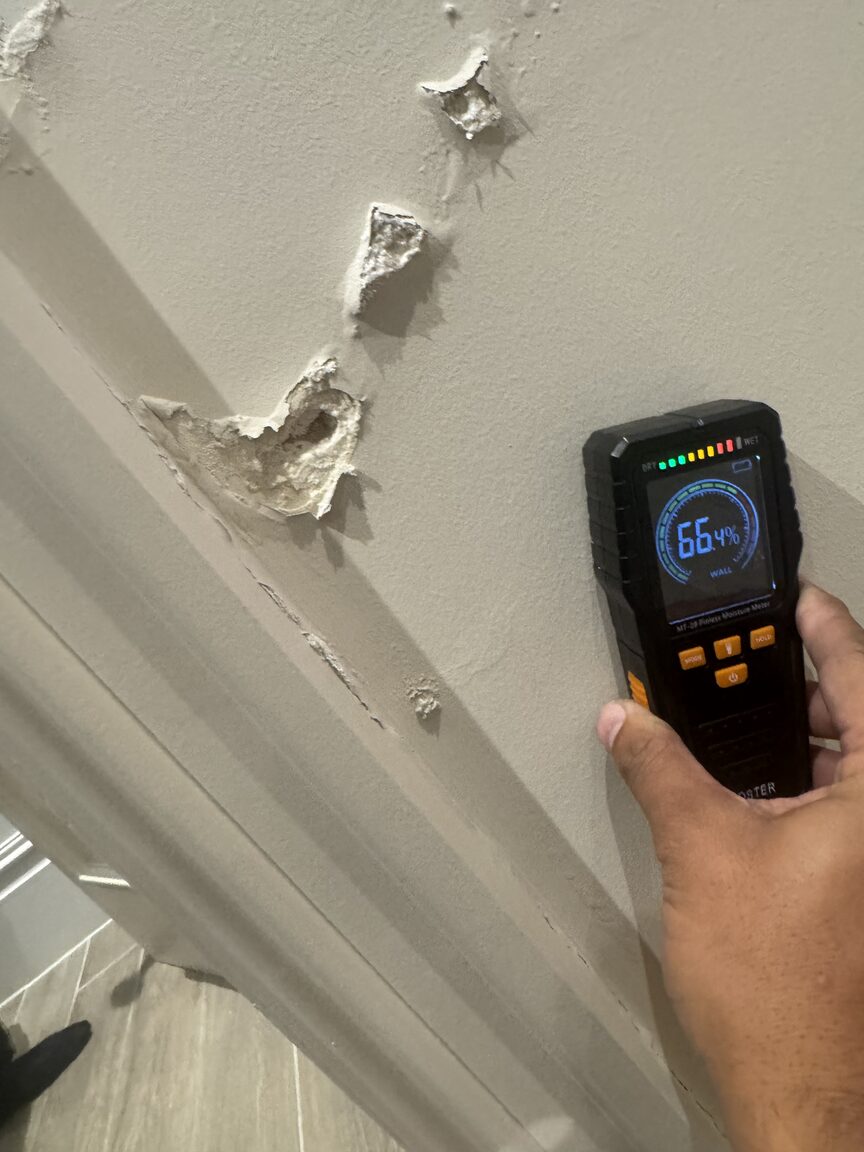
- Moisture confirmation: Any cold or warm anomalies identified on the thermal image are cross-checked with a moisture meter. This confirms that the anomaly is caused by actual moisture rather than, say, a cold air draught or a structural variation.
- Report and mapping: The surveyor produces a report showing exactly where the moisture is present, how extensive it is, and (where possible) the likely source of the leak.
What Types of Leaks Can Thermal Imaging Find?
Thermal imaging is effective across a wide range of leak scenarios:
- Underfloor heating leaks: Warm water escaping from a pipe under a screed or timber floor creates a distinct heat signature that is almost impossible to locate any other way.
- Cold water supply leaks: A slow drip from a cold pipe behind a wall creates a cooling pattern that stands out against the surrounding material.
- Roof and flat roof leaks: Water ingress through a flat roof pools and saturates insulation. Thermal imaging conducted at dusk (when the roof surface is cooling) reveals these wet patches clearly.
- Central heating pipe leaks: Hidden pipe runs beneath floors or inside walls can be traced by following the heat signature of the flow and return pipes, with leaks showing as irregular hot spots.
- Bathroom and wet room leaks: Water migrating from shower trays or baths into adjacent walls and floors is a common source of hidden damp, thermal imaging maps the extent of ingress quickly.
Why Non-Invasive Detection Matters
The traditional approach to finding a hidden leak involves opening up the building fabric, drilling, cutting, lifting, breaking. This causes significant secondary damage, often far more extensive than the leak itself. A straightforward pipe leak behind a tiled bathroom wall could result in an entire tile wall being stripped before the problem is found.
Thermal imaging leak detection avoids this entirely. Because the surveyor can see moisture through the surface, there is no guesswork and no unnecessary destruction. When repairs are needed, contractors can open up precisely where the leak is. Minimising disruption, reducing repair costs, and getting the property back to normal faster.
This is particularly valuable for insurance trace and access claims. Insurers require evidence of where the leak is before authorising repair work. A thermal imaging survey provides exactly that: a documented, professional report that satisfies insurers and speeds up the claims process.
Is Thermal Imaging Alone Enough?
Thermal imaging is a powerful tool but it works best as part of a wider diagnostic approach. On its own, a thermal camera shows temperature anomalies. It does not directly measure moisture content or identify pipe locations. A skilled surveyor combines thermal imaging with moisture meters, pipe-tracing equipment, and building knowledge to build a complete picture.
The best leak detection companies use thermal imaging as a first-pass diagnostic tool and then apply the appropriate secondary technology to confirm their findings. This combination approach produces accurate results quickly, usually within a single visit.
Get a Professional Thermal Imaging Survey
If you have unexplained damp patches, a rising water bill, or the smell of mould without an obvious source, a thermal imaging leak detection survey can find the problem without tearing your property apart.
Damp Mould Leak provides professional thermal imaging surveys across London and Surrey. Our surveyors use calibrated equipment and produce detailed written reports, giving you and your insurer everything needed to move forward with confidence.
Call us on 0800 054 1524 or visit dampmouldleak.co.uk to book your survey today.
Last reviewed: 27 October 2026. Independent investigation and written reports. Repairs are quoted separately.