Damp · Mould · Leak in Blackheath
Damp, Mould & Leak Detection in Blackheath
Specialist damp and mould surveys, leak detection and insurance-ready reports across Blackheath and the surrounding area. Non-invasive methods first, with a clear written report.
Get a call back☎ 0800 054 1524WhatsApp us
Fully insured · Non-invasive methods first · Written reports included · London & Surrey
Blackheath’s appeal is its fabric: Georgian and early-Victorian villas facing the heath, the elegant terraces of the village and the Cator Estate, and substantial later-Victorian and Edwardian family houses running down towards Lee and up to the Standard. Fabric of that age rewards careful ownership, and punishes guesswork. Damp in a 180-year-old solid-walled villa is rarely solved by the first company that offers to inject it; it is solved by finding out precisely where the moisture originates. That diagnostic discipline is the heart of what our team offers throughout SE3.
Period Property, Period Moisture
Older Blackheath houses were built without cavities, without membranes and, in the earliest cases, without any damp-proof course at all. They managed moisture by breathing: permeable lime mortars and plasters, open flues and generous ventilation let water vapour escape as fast as it arrived. Problems tend to start when that balance is disturbed, cement render and pointing trapping moisture in soft brick, impermeable modern paints on old plaster, sealed chimneys, blocked sub-floor vents, or external ground levels crept up over two centuries of resurfacing. Our damp surveys are built for exactly this stock: moisture profiling through the wall, thermal imaging, hygrometry and salts analysis where needed, distinguishing true rising damp from trapped moisture, penetrating rain, condensation and plumbing escapes. The written report tells you what the building actually needs, which, with period property, is frequently more breathability rather than more chemicals.
Basements, Semi-Basements and Below-Ground Rooms
Many of the village’s older houses have cellars or lower-ground floors, and the heath’s geology (gravels over London clay) means water moves laterally and appears where it isn’t expected, especially on the slopes down towards Lee and Lewisham. Persistent dampness in below-ground rooms can stem from defective external drainage, failed or absent tanking, condensation on cool masonry, or simple lack of air movement. We investigate before recommending: identifying the water’s route matters enormously when the remedies on offer range from a repointed gully to a full structural waterproofing system.
Tracing Leaks Without Wrecking Historic Fabric
In a listed or simply beautiful old house, exploratory demolition is not an acceptable diagnostic method. Our leak detection engineers locate hidden escapes (ageing heating circuits, original supply pipes, concealed wastes, roof and parapet failures) using acoustic sensors, tracer-gas testing and thermographic inspection paired with careful moisture mapping, narrowing the source to a precise point before anything is touched. When an insurance claim follows, our trace and access service opens up the minimum necessary to expose the failure and provides the report insurers require. On buildings where every floorboard and cornice matters, that restraint is the whole value of the service.
Mould in Well-Sealed Old Houses
A curious pattern of the last two decades: sensitively refurbished period homes developing mould they never had before. Double glazing, draught-proofing and insulation cut heat loss but also cut air changes, and winter moisture that once vanished up the chimney now condenses on the coldest surfaces: window reveals, north-facing corners, behind wardrobes on external walls. Our mould treatment removes growth safely, treats the affected surfaces and then deals with the imbalance itself, specifying ventilation and detailing changes suited to the age of the building rather than off-the-shelf fixes designed for new-builds.
Drainage and External Moisture
Victorian drains serve most of SE3, and after a century-plus of clay movement and root intrusion many are quietly defective. Where a wall base never dries, a cellar smells wet, or gullies stand full after rain, we run CCTV drainage surveys to inspect the below-ground runs and establish whether escaping foul or surface water is loading the ground against the house, evidence that turns a vague damp problem into a specific, fixable defect.
What we do in Blackheath
Every job starts with finding the real cause, not painting over the symptom.
Damp surveys
A proper diagnosis (rising, penetrating or condensation damp) with moisture readings and a written report.
Mould inspections & treatment
We identify the moisture source first, then treat the mould and tackle the cause.
Leak detection
Thermal imaging, acoustic listening and moisture tracing to pinpoint hidden leaks without ripping out walls or floors.
Trace & access
We locate the leak, expose the exact spot and document everything for your escape-of-water claim.
Insurance-ready reports
Clear, evidenced reports prepared to support insurance, landlord, agent or housing matters.
Moisture mapping & thermal imaging
Calibrated readings and thermal surveys that show exactly where the moisture is, and where it isn’t.
CCTV drainage surveys
Camera surveys that find blockages, collapses and leaking joints that feed damp into a property.
Emergency leaks
Urgent cases are prioritised when water is coming through a ceiling or a pipe has burst.
Real investigations by our team
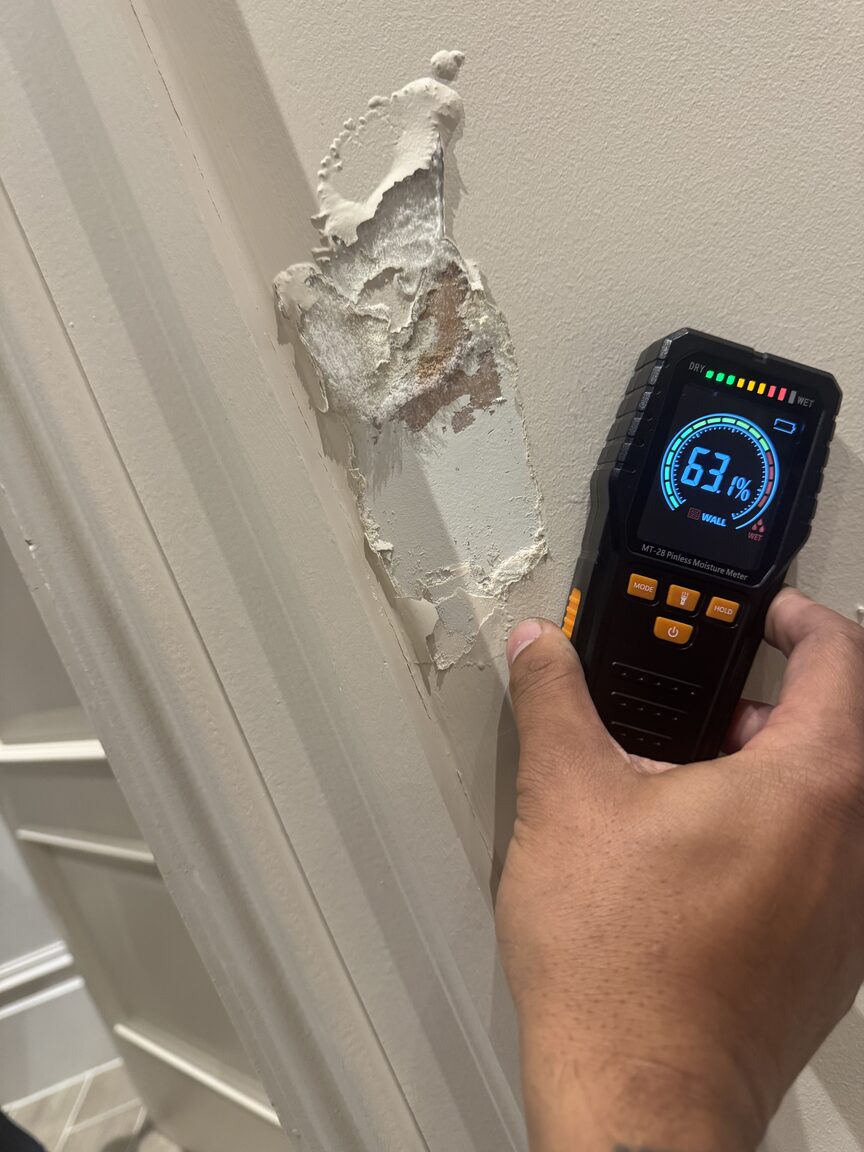
Genuine photographs from DML jobs across London & Surrey, not stock imagery.


How we investigate
Non-invasive first. We open up only when we know exactly where the problem is.
Visual inspection
A methodical room-by-room inspection of the affected areas, inside and out.
Moisture readings
Calibrated moisture meter readings across walls, floors and ceilings.
Thermal imaging
Infrared scanning, where suitable, to reveal hidden moisture and cold spots behind finishes.
Acoustic & tracer gas
Acoustic listening and tracer gas, where suitable, to pinpoint concealed pipe leaks.
Pressure testing
Pressure testing of heating and supply pipework where suitable.
Photos & written report
Photographs, readings and clear findings in a written report you can act on.
Nearby & related coverage
We cover the village and heath fringes, the Cator Estate, Westcombe Park edges, the Standard and the residential streets running towards Kidbrooke and Lee, with the wider borough on our Greenwich page and neighbouring coverage in Catford.
Insurance, landlords and tenants in Blackheath
Reports prepared to support insurance, landlord, agent or housing matters. Trace and access may be covered under buildings insurance, depending on the policy. We provide the photographs, readings and written evidence to support the claim. For landlords and housing providers, our reports are suitable as supporting evidence for housing, landlord or compliance matters. Written workmanship terms apply where relevant.
Book a damp, mould or leak investigation in Blackheath
Covering Blackheath and the surrounding area. Call free, WhatsApp us, or request a call back and one of our team will get straight back to you.
Get a call back☎ 0800 054 1524WhatsApp us
Insured
Included
Prioritised
Evidence Reports
Terms
Get a call back about your Blackheath property
Tell us what’s happening and one of our team will call you back. For urgent problems call 0800 054 1524.
Frequently asked questions: Blackheath
Our early-Victorian house has no DPC at all. Does it need one injected?
Not necessarily: thousands of pre-DPC houses stay dry through good detailing: sound pointing, working rainwater goods, low external ground levels and breathable finishes. We assess whether yours is genuinely wicking ground moisture or suffering something else entirely before any irreversible treatment is considered.
Condensation or penetrating damp. How do you tell on a solid wall?
By measurement. Moisture profiles through the wall depth, surface temperatures and dew-point analysis separate the two reliably: penetrating damp is wetter at depth, condensation at the surface. It matters, because the fixes have nothing in common.
Do you work on listed buildings and homes in the conservation area?
Yes. Our methods are non-invasive first, and our recommendations respect the fabric, breathable materials, minimal intervention and repairs consistent with the building’s construction. Where consent implications arise, our reports give you and your architect the evidence to plan around.
Selling or buying in the village?
Pre-purchase damp investigations are a large part of our Blackheath work. A vague “high moisture readings noted” line in a valuation survey can unsettle a sale out of all proportion to the reality; an independent, instrument-based diagnosis either identifies a genuine defect to price in or clears the point entirely, and either outcome keeps the transaction moving on facts.
Last reviewed: 27 October 2026. Independent investigation and written reports. Repairs are quoted separately.