Central Heating Leak Detection — No-Dig, No-Mess
Pinpoint heating leaks beneath floors and behind walls using thermal imaging, acoustic detection and tracer gas.
Why Central Heating Leaks Are Difficult to Find
Central heating pipe systems run beneath floors, inside wall chases and through ceiling voids — locations that are hidden from view and difficult to access without significant disruption. When a pipe develops a leak, the water often travels a considerable distance through the screed, insulation and structure before it appears as a damp patch, stain or area of wet flooring.
By the time a central heating leak becomes visually apparent, water may have been saturating the subfloor for weeks or months. The visible damp is rarely directly above the leak source. This is why traditional exploratory access — lifting floor tiles, removing skirting boards — is often unsuccessful and results in large areas of disruption without finding the source.
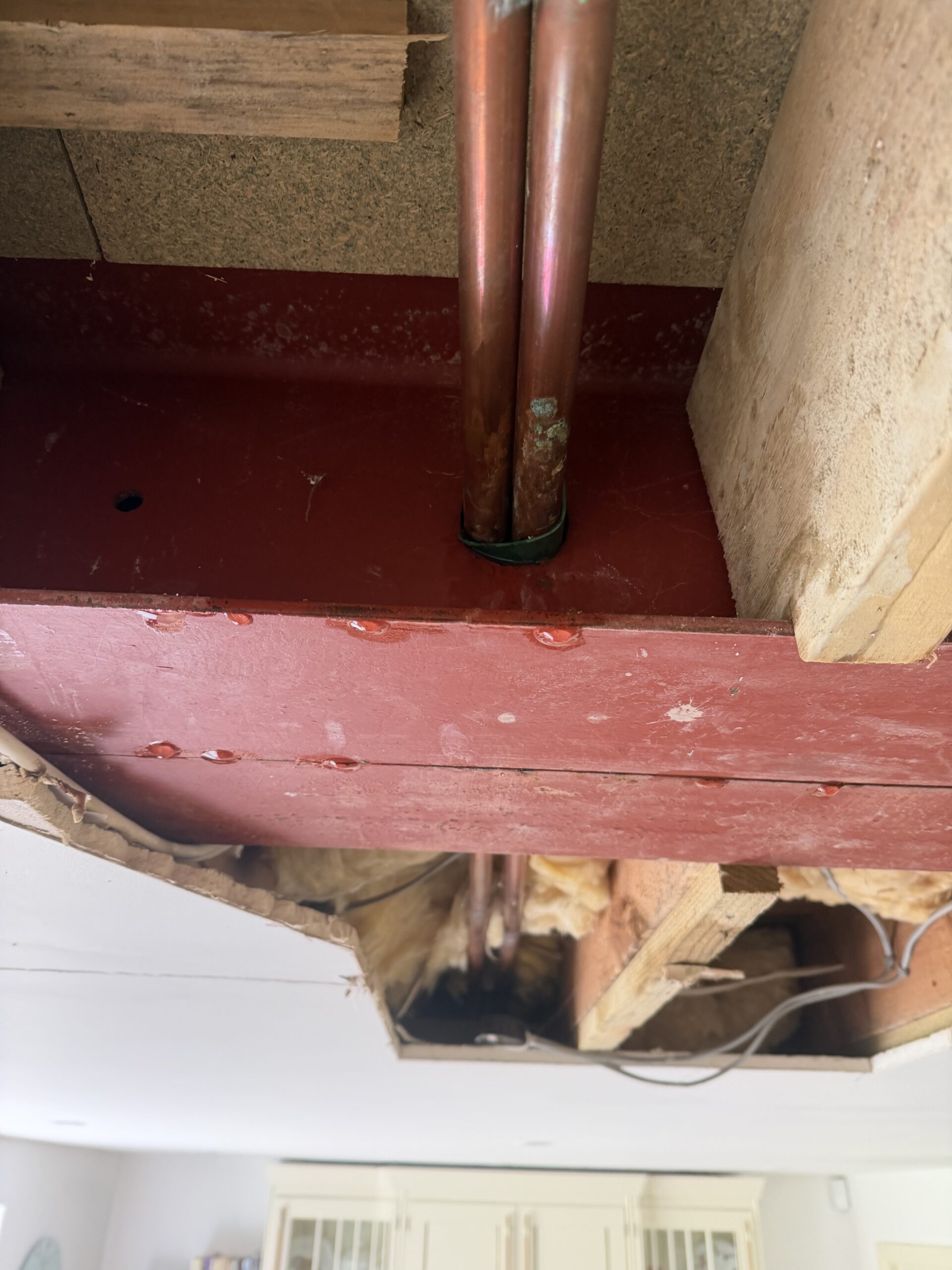
Common Causes of Central Heating Leaks
Central heating systems develop leaks through several mechanisms:
- Pinhole corrosion — the most common type. Corrosion from dissolved oxygen and hydrogen pitting eats through copper pipe walls from the inside, creating tiny but persistent leaks
- Failed soldered or compression joints — joints that have worked loose over time, often due to thermal expansion and contraction cycling
- Electrochemical corrosion — where dissimilar metals meet in the system (copper and steel) accelerating corrosion at connection points
- Mechanical damage — pipes cracked during installation, building work or ground movement
- Freeze damage — pipes cracked by freezing in exposed locations
- Underfloor heating pipe failure — degradation of barrier pipe in screed systems, typically at joints or where pipes have been damaged
Our Detection Methods
Thermal Imaging
Thermal cameras detect the temperature differential between a leaking pipe (warm) and the surrounding screed or structure. Particularly effective for underfloor heating leaks and pipework within screed floors.
Acoustic Listening
Acoustic leak detectors and ground microphones amplify the sound of water escaping from pressurised pipes. The characteristic frequency pattern of a pipe leak is distinctive and can be traced to within centimetres.
Tracer Gas
We pressurise the suspect circuit with a non-toxic hydrogen/nitrogen tracer gas mixture. The gas escapes from the leak and rises through the floor or wall material to the surface, where it is detected using a precision sniffer. Accurate to within 2–3cm in most substrates.
Pressure Testing
We isolate individual pipe circuits and monitor pressure decay to confirm a leak is present and quantify its severity before beginning detection work.
Underfloor Heating Leak Detection
Underfloor heating systems present particular challenges because all pipework is embedded within floor screed — typically 50–80mm below the finished floor surface. Tracer gas detection combined with thermal imaging allows us to locate leaks in underfloor heating systems precisely, minimising the area of screed that needs to be broken out for repair.
We work across all underfloor heating types — wet screed systems, suspended timber floors, aluminium spreader plate systems and electric systems where water pipe failures are involved.
How long does central heating leak detection take?
Typically 2–4 hours for a residential property. We will give you a realistic estimate once we have discussed the symptoms and system layout with you.
Can you detect leaks without draining the system?
In most cases, yes. Our tracer gas method works on pressurised systems. Thermal imaging also works while the system is running. Pressure testing requires circuit isolation but not necessarily full drainage.
Do you repair as well as detect?
Yes. Our in-house plumbers can carry out the repair once the leak is located. We make a targeted access point, complete the repair and reinstate all flooring and finishes.
Does insurance cover central heating leak detection and repair?
Many buildings insurance policies cover trace and access costs — the cost of finding and accessing the leak — as well as the repair. We provide insurer-accepted reports to support your claim.
Warning Signs of a Central Heating Leak
Central heating leaks are often silent for months before becoming obvious. Watch for:
- Dropping system pressure — if your boiler pressure falls below 1 bar repeatedly without explanation, a slow leak in the circuit is the most likely cause
- Warm or hot areas of floor — particularly in properties with underfloor heating, warm patches on a screed floor indicate a leak in the UFH circuit beneath
- Staining or dampness on ceilings — brownish staining on ceilings directly below bathrooms or wet rooms, or in locations with no obvious plumbing, may be a concealed heating pipe
- Wet or soft areas of floor covering — carpet, vinyl or laminate flooring that feels damp or spongy in areas not near obvious plumbing
- Increased water bills — if your property’s water usage has increased without explanation, a slow continuous leak may be refilling the heating system
- Rust-coloured water in the expansion vessel — indicating active corrosion in the system, which often precedes pinhole pipe failure
What not to do: Never attempt to pressurise the system repeatedly to compensate for pressure loss — this worsens the leak and accelerates structural water damage. Turn off the heating system and call us immediately.
Thames Water Mains vs Your Heating System — What’s Responsible?
A common source of confusion is the boundary between your internal heating system and the external water supply infrastructure. In properties across London served by Thames Water, and in Surrey properties served by South East Water or Affinity Water, the water company is responsible for the mains supply pipe up to your property boundary — but everything from the external stop tap inward is the homeowner’s responsibility.
Your central heating system runs on a closed circuit — it is filled from the mains but does not continuously draw water (unless your system has auto-filling). A pressure drop in the heating circuit means water is escaping from within your property. Thames Water, South East Water and Affinity Water are not responsible for internal heating system leaks.
Where you have experienced a Thames Water or South East Water mains burst nearby, associated ground movement can occasionally crack internal pipe runs — particularly in older properties. Our reports clearly identify the leak source and mechanism, which is important for any insurance or liability claim.
Central Heating Leak Detection — Cost Guide
Detection Survey
Thermal imaging, acoustic detection and tracer gas — all methods used as required. Confirmed leak location marked. Written report included.
Pipe Repair
Targeted access, pipe repair and reinstatement. Pricing depends on pipe depth, material and access requirements. We provide a fixed quote before any work begins.
Insurance Claims
Where trace and access cover applies, detection costs may be fully recoverable from your insurer. We advise on this during the initial call.
More Questions Answered
My boiler engineer says there’s a leak but can’t find it — what now?
Boiler engineers typically assess the boiler itself and readily accessible pipework, but are not equipped with the specialist detection equipment needed to locate concealed leaks. Once an engineer has confirmed pressure loss and ruled out air in the system, specialist leak detection is the appropriate next step. We can usually locate the source in a single visit.
Can a central heating leak cause structural damage?
Yes. Hot water escaping into a screed or sub-floor can soften and destabilise the screed, cause timber rot and joist decay, and create conditions for mould growth within the floor void. Extended leaks can cause significant structural damage — early detection is important. We assess water damage extent as part of every investigation.
Is underfloor heating leak detection covered by insurance?
Many buildings insurance policies include trace and access cover which applies to underfloor heating leaks. The trace and access section covers the cost of finding the leak and reinstating the floor after repair — not the pipe repair itself (which falls under a separate section). We provide insurer-accepted reports as standard. Check your policy schedule for trace and access limits before calling your insurer.
Areas We Cover
We operate across South London, North London, East London and throughout Surrey — typically within a 20-mile radius of Cheam, SM3.
South London
- Croydon
- Sutton
- Merton
- Wimbledon
- Tooting
- Balham
- Clapham
- Streatham
- Lambeth
- Wandsworth
- Kingston
- Richmond
- Thornton Heath
Surrey
- Guildford
- Woking
- Epsom
- Leatherhead
- Reigate
- Redhill
- Dorking
- Camberley
- Farnham
- Staines
- Weybridge
- Esher
- Cheam
North & East London
- Hackney
- Islington
- Camden
- Haringey
- Walthamstow
- Stratford
- East Ham
- Ilford
- Romford
- Barking
- Lewisham
- Greenwich
Not sure if we cover your area? Call us on 0800 054 1524 — we’re happy to advise.
Ready to Get Started?
Surveys available across London and Surrey. Same-day attendance available.