Roof Leak Detection & Repair Across London & Surrey
Find the true source of your roof leak — then fix it properly. Not just the symptom.
Why Roof Leaks Are Difficult to Diagnose
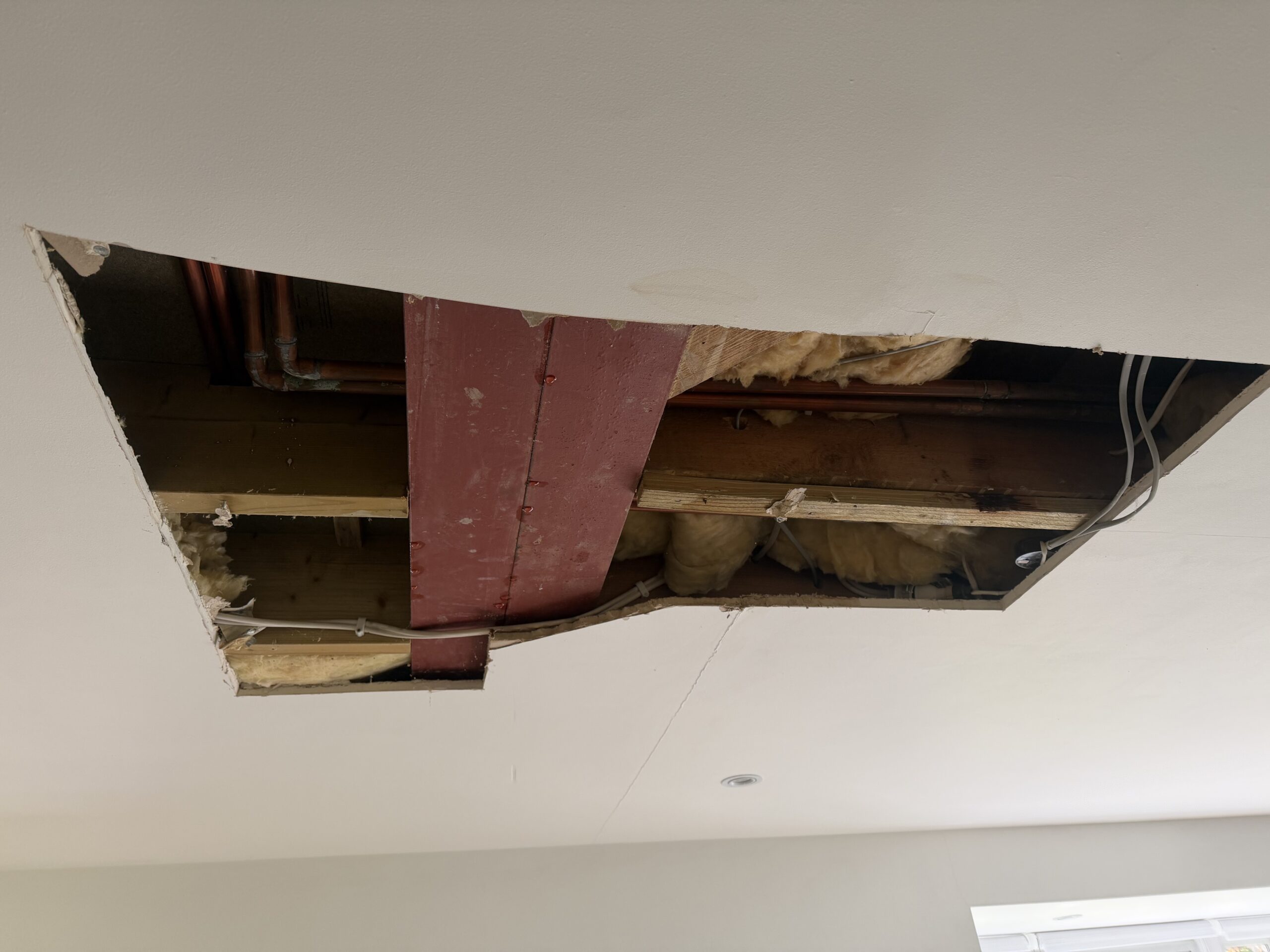
A roof leak is one of the most common and most misunderstood property defects. The point where water appears inside the property — a damp patch on a ceiling, water staining down a wall — is almost never directly below where the water is entering the building. Water enters at a defect in the roof covering or flashing and then tracks along joists, through insulation and down through ceilings before it becomes visible.
This means that simply identifying the visible damage and working upwards is unreliable. A professional roof leak investigation uses systematic techniques to trace the water’s path back to its true entry point — saving time, money and unnecessary disruption.
Common Causes of Roof Leaks
Failed Flashings
Lead flashings around chimney stacks, dormer windows, skylights and where the roof meets a parapet wall are the most common source of roof leaks in older properties. Lead fatigues and cracks over time. Soaker flashings within tile courses corrode and fail.
Damaged or Slipped Tiles
Broken, cracked or slipped roof tiles are immediately obvious to inspection but are often not the primary cause — they are frequently symptoms of deeper issues with the battening, felt or structure. We assess the full roof condition.
Flat Roof Failure
Flat roofs have a significantly shorter lifespan than pitched roofs and are vulnerable to ponding, membrane deterioration and seam failure. Modern GRP (fibreglass) and EPDM roofs have better longevity than traditional felt.
Blocked or Defective Gutters
Overflowing or leaking gutters — particularly box gutters and valley gutters — channel large volumes of water back into the roof structure. Even small blockages can cause significant ingress over time.
Storm and Wind Damage
High winds lift tiles, dislodge ridge and hip tiles, and damage TV aerial and satellite dish fixings, all of which can create immediate water ingress paths.
Inadequate Roof Ventilation
Insufficient ventilation in roof spaces causes condensation to accumulate on cold surfaces, including the underside of felt and structural timbers. This is commonly misdiagnosed as an external roof leak.
Our Roof Leak Investigation Process
- External inspection— systematic examination of all roof coverings, flashings, gutters, ridge and hip tiles, verges, abutments and penetrations
- Internal inspection— inspection of the roof space (where accessible) examining felt, battening, structure and any signs of water ingress, staining or rot
- Thermal imaging— identification of areas of moisture saturation in ceiling and roof space materials that are not yet visible as damage
- Water testing— where the entry point is uncertain, controlled water testing of specific roof elements to confirm entry points
- Written report— full report with findings, photographic evidence, identified defects, recommended repairs and costings
Can you repair as well as detect?
Yes. Our in-house team carries out roof repairs including flashing replacement, tile repairs, gutter repairs and flat roof patching and membrane replacement.
Do you carry out full roof replacements?
We specialise in investigation, defect repair and waterproofing rather than full roof replacement contracts. Where a full replacement is needed, we will advise accordingly.
Can roof condensation look like a roof leak?
Yes, and it frequently does. Inadequate roof ventilation causing condensation to drip from the underside of felt is one of the most common misdiagnoses in roof defect investigation. Our survey will confirm which is present.
Water Infrastructure in Roof Leaks
Roof Leaks is served by Thames Waterfor both water supply and sewerage. When Thames Water mains pipes fail — particularly the Victorian-era cast iron infrastructure common across South and East London — the resulting ground saturation can cause significant water ingress into nearby properties. If you have experienced unexplained damp following a Thames Water mains burst or repair in your area, our independent investigation reports establish the connection between the infrastructure event and damage to your property, supporting both Thames Water claims and buildings insurance claims.
Ready to Get Started?
Surveys available across London and Surrey. Same-day attendance available.
Frequently Asked Questions
How long does a damp survey take?
A standard residential damp survey takes 1–2 hours depending on property size. We check all accessible areas including loft space (if safe and accessible), subfloor (if there is a suspended floor), external walls, internal walls, and roof. The written report with moisture readings is provided within 24–48 hours.
Is black mould dangerous?
Black mould — particularly Stachybotrys chartarum — produces mycotoxins that are harmful to health, especially in children, elderly people, and those with respiratory conditions. Even common mould species (Aspergillus, Penicillium, Cladosporium) found in damp UK properties can cause allergic reactions and respiratory problems. Professional treatment and resolution of the underlying damp cause is strongly recommended.
What are the signs of a hidden water leak?
Signs of a hidden leak include: unexplained wet patches on walls or ceilings with no obvious source, water meter turning when all taps are off, low water pressure, musty smells in rooms with no visible damp, and damp patches that appear and disappear. Acoustic and thermal imaging leak detection can locate hidden leaks without unnecessary damage.
Can you treat mould without a survey first?
We recommend a survey before treatment in most cases — particularly for severe or recurring mould, or where the cause is not clearly condensation. Treating mould without identifying the cause risks the mould returning quickly. For straightforward condensation mould in well-ventilated rooms, a survey may not always be necessary — call us and we will advise based on your specific situation.